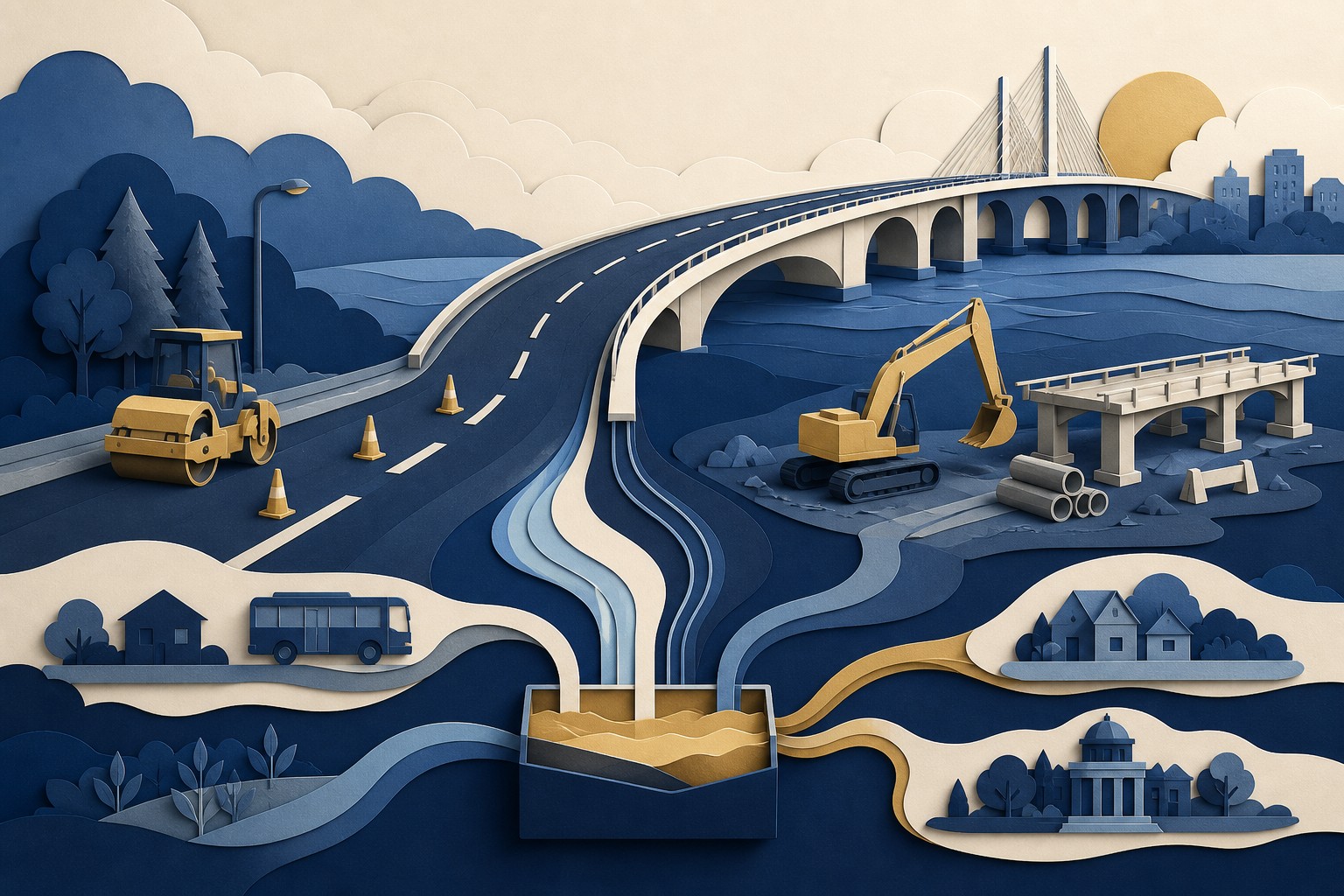
A road runs through your community, a crew starts work, and a familiar question follows: Who is paying for this?
The most accurate answer often begins with another question: Which government or public authority is responsible for this road? The city name on a mailing address does not necessarily identify the road owner, the maintenance agency, or every source supporting a project.
Local infrastructure is usually easier to understand when you separate four roles: ownership, day-to-day responsibility, project delivery, and funding.
§ Start with the responsible agency
Road systems can involve municipal, county, state, federal, tribal, or special-purpose entities. Responsibility may also differ by segment, bridge, intersection, or type of work.
The agency that maintains a road may coordinate with another government on design, construction, permitting, utilities, or reimbursement. A contractor performing the work is not necessarily the public entity that owns the asset or makes the funding decision.
Before looking for a budget line, identify the route, asset, and responsible agency through an official transportation map, project page, public works contact, or adopted capital plan.
§ Routine maintenance and capital work are different decisions
Patching, snow response, signals, sweeping, striping, and ordinary repairs are commonly treated as operating or maintenance activities. Reconstructing a road, replacing a bridge, or making a major long-lived improvement may be treated as a capital project.
The boundary is not identical everywhere. A government's capitalization policy, budget rules, project scope, and accounting system matter. Still, the distinction helps you look in the right place.
Routine work may appear in a public works operating budget. A major project may appear in a capital improvement plan, capital budget, transportation program, grant agreement, or debt document. It can also create future operating costs after construction ends.
§ One project can use a mix of resources
Road work may draw on general revenue, dedicated taxes or fees where authorized, state or federal assistance, grants, transfers, borrowing, assessments, or contributions from other entities. Not every source is available for every road or activity.
A restricted grant may support eligible construction but not every maintenance expense. Debt may provide financing for a long-lived project, but repayment still requires future resources. An interfund transfer can move resources between funds within the same government; it does not mean new money entered that government as a whole.
This mix is why it is risky to say that one local tax “paid for the road.” The guide to local tax flows explains how several sources can move through general, restricted, and intergovernmental pathways.
§ Federal aid does not reach every local road in the same way
Federal highway assistance operates through programs, eligibility rules, planning requirements, and state or regional processes. A project may require a nonfederal share. Another local road or maintenance activity may not be eligible for that program at all.
Federal participation also does not mean the federal government owns the road. Funding, ownership, project oversight, and ongoing maintenance are separate questions.
For a real project, the useful evidence is its official funding plan: which program is named, which entity receives or administers the assistance, which costs are eligible, and which government supplies the remaining resources.
§ Why project timing can change
A project shown in a plan may move because design, environmental review, right-of-way, utility coordination, procurement, permits, bids, or funding agreements are not complete. Revenue timing and construction conditions can also affect sequencing.
Delay does not automatically prove that funds disappeared. Nor does a project list prove that all financing is secured. Look for changes in the capital plan, adopted budget, project page, and governing-body records.
A capital improvement plan can help distinguish an identified project from a fully authorized and funded commitment, but its local definitions still need to be read carefully.
§ Six questions for a road project
When you want to understand a specific road or infrastructure project, ask:
- Who owns or is legally responsible for the asset?
- Is the work routine maintenance, rehabilitation, or a capital improvement?
- Which official document identifies the project and its current phase?
- Which resources are proposed, awarded, transferred, or borrowed?
- Which conditions limit how those resources may be used?
- Who will pay for operation and maintenance after completion?
These questions connect visible construction to the less visible decisions behind it.
§ Follow responsibility before following dollars
Road finance is not one national formula. It is a chain of responsibility, eligibility, authorization, timing, and funding. Starting with the responsible agency keeps the search focused. Separating maintenance from capital work tells you which documents to open next.
The Insights library includes more practical guides to budgets, funds, and public decisions.
§ Sources and further reading
- Federal Highway Administration — Federal-Aid Highway Program
- Federal Highway Administration — Highway Finance Data Guide
- Federal Highway Administration — Local Government Highway Finance
- U.S. Census Bureau — Government Finance Classification Manual