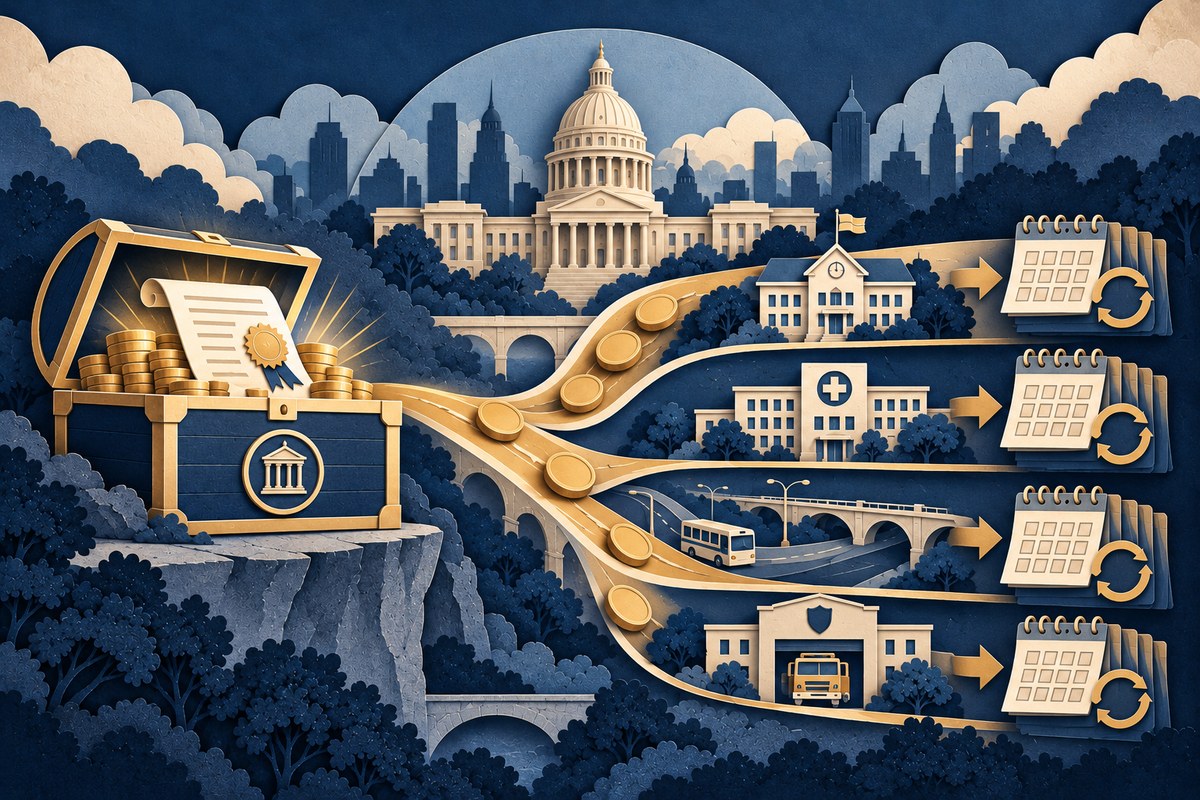
A government can receive a large amount of real money today and still be unable to support a new expense safely next year.
The key question is:
Will the money come back?
A one-time receipt can be an excellent way to pay a one-time bill. The problem appears when temporary resources are used to create or maintain a commitment that returns every year.
§ What counts as one-time revenue?
One-time revenue is money that should not be assumed to recur at the same level in future budgets.
Examples can include asset-sale proceeds, a legal settlement, a temporary grant, an extraordinary transfer, or an unusually high portion of a volatile revenue source.
A revenue category can exist every year and still contain a temporary component. An unusually strong year should not automatically become the new permanent baseline.
§ Why ongoing costs are different
Ongoing costs return.
Examples include salaries and benefits for permanent positions, recurring service contracts, software subscriptions, routine program operations, and maintenance required to keep a service running.
That creates the mismatch to watch:
temporary resource + recurring obligation
Suppose a city receives a $3 million legal settlement and uses it to launch a permanent program costing about $3 million a year.
The first year may be fully funded.
The second year is not.
Unless recurring revenue increased, another source must replace the settlement.
§ Why financial policies focus on this distinction
GFOA connects one-time revenue policy directly to structural budget balance.
The basic principle is that temporary resources generally fit temporary needs better than recurring costs.
That is not an absolute legal rule. Local laws, emergencies, financial strategies, and economic conditions differ.
There can be reasonable exceptions, including recessions, disasters, temporary revenue shocks, or transition periods. The important question is whether temporary financing comes with a credible exit plan.
§ Volatile revenue deserves special attention
Some temporary resources do not look like windfalls.
A government may collect the same tax every year but receive an unusually high amount in one year. The tax is recurring; the unusually high portion may not be.
That is why revenue forecasting matters. Decision-makers need to distinguish the stable base from a temporary spike before creating permanent spending.
§ Six questions for readers
When you see a large revenue item in a local budget, ask:
- Is this resource expected to recur?
- Is the amount unusually high compared with recent years?
- What expense is it funding?
- Will that expense return next year?
- If the revenue disappears, what recurring source replaces it?
- Does the government's financial policy explain how one-time revenue should be used?
A one-time dollar is still a real dollar.
But it should not be confused with a permanent revenue stream.
§ Sources and further reading
- GFOA — One-Time Revenue Policy Template
- GFOA — Achieving a Structurally Balanced Budget
- GFOA — Structural Budget Balance
For the broader framework, read What Is a Structurally Balanced Budget?.