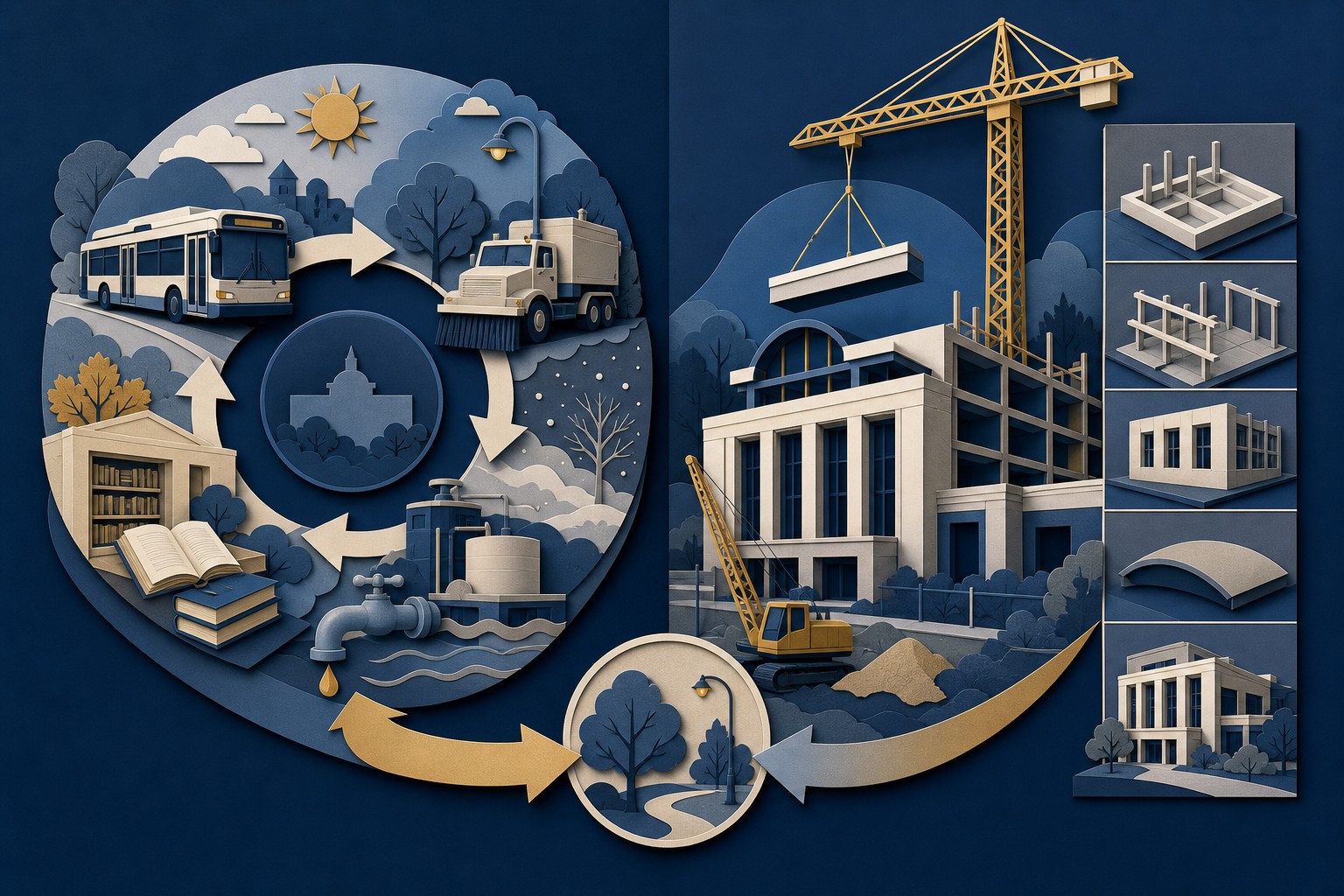
A public budget may place employee salaries, fuel, a new building, vehicle replacement, and debt service in different sections. The separation is not cosmetic. Everyday services and long-lived investments create different planning questions.
An operating budget generally focuses on recurring activities and the resources needed to provide services during a budget period. A capital budget focuses on acquiring, constructing, or substantially improving long-lived assets under the government's definitions.
The boundary varies, and the two budgets are connected.
§ The operating view follows services through the year
Operating budgets commonly include personnel, supplies, contracts, utilities, routine maintenance, and other costs of delivering services. They also identify recurring and nonrecurring revenue available for those activities.
The practical question is sustainability: can the government support the service not only this year but in later periods? A one-time resource can legally support an operating item in some circumstances, but it does not repeat automatically next year.
Read staffing, service levels, revenue assumptions, and departmental explanations together. A total increase can reflect wages, volume, contracts, new responsibilities, or classification changes.
§ The capital view follows assets and projects
Capital budgets commonly authorize spending for long-lived infrastructure, facilities, equipment, or major improvements. Projects may span more than one year and combine current revenue, restricted resources, grants, transfers, or borrowing.
A government's capitalization policy and budget rules determine what qualifies. There is no universal dollar threshold or asset list. Routine repair can remain operating while a larger improvement is capital, but the local policy and project scope control the classification.
A Capital Improvement Plan may look across several years, while a capital budget or appropriation grants authority for a defined period or project. Plan and budget are related, not interchangeable.
§ Financing is not the same as project cost
A capital project can be financed when debt is issued, built over several periods, and repaid long after completion. Debt proceeds supply financing; principal and interest create later budget demands. Grants may cover eligible costs but carry restrictions and timing conditions.
Separating financing from expenditure prevents double counting and prevents a bond issue from being treated as free revenue.
For the broader framework, see What Is a City Budget—and Why Should You Care?.
§ Capital choices create operating consequences
A new library, park, road, system, or vehicle fleet does not stop costing money when construction or acquisition ends. It may require staff, energy, software, insurance, inspection, supplies, routine maintenance, and eventual replacement.
The capital decision should therefore identify future operating effects. A lower construction cost does not automatically mean a project is affordable to operate. Conversely, a capital investment can reduce some operating needs; that claim still requires evidence.
This connection is the most important reason to read operating and capital plans together.
§ Compare the budgets without mixing them
Ask what period each document covers, what the local policy calls capital, which funds and entities are included, whether amounts are project totals or current-year appropriations, which financing sources are secured, and what operating impact is recognized.
Then trace shared items. Debt service may appear in operating or separate debt-service presentations. Staff for a new facility appears in operations. A transfer can connect funds. A grant may appear in the capital project and later reporting.
Do not conclude that capital spending competes dollar-for-dollar with every operating service. Restrictions, debt terms, grants, and legal authority may limit alternatives. But do ask about the real tradeoffs among eligible uses and future commitments.
§ A compact reader checklist
- Is this an operating cost, capital outlay, financing source, or debt payment?
- Is the amount annual, multi-year, or total project cost?
- Which source pays, and what restrictions apply?
- What authorization exists now?
- Which operating costs begin after completion?
- Where will actual results appear?
§ Two views of one public service system
Operating and capital budgets answer different questions, but they describe one government. Services rely on assets; assets require operations. Strong civic reading keeps the categories distinct and then reconnects them over time.
The Insights library offers more guides for reading those relationships.
§ Sources and further reading
- U.S. Census Bureau — Government Finance Glossary
- U.S. Census Bureau — Government Finance Classification Manual
- Federal Highway Administration — Capital Improvement Programming Primer
- Washington State Auditor — Budgeting Introduction